Memorial Day weekend is here where we celebrate our freedoms brought to us through the sacrifices made by the men and women throughout the military. We do this through our own sacrifices made by eating too many BBQ’d meals, going on vacations and hanging out around the occasional parade. 

It is also the time of the year when people will get their first sunburn of the summer. If you forgot the suntan lotion and have one of the following in your home.  

Home remedies for Sunburns:

1.  Undiluted apple cider vinegar to sunburn.
2. Mix 10 ounces Non-fat Dry Milk, 2 tablespoons salt and 25 ounces water. Saturate cloth and apply to sunburn 20 minutes. -A milk bath of sorts
3. Mayonnaise as a skin cream to sunburn.
4. Peanut oil to sun-burned areas.
5. Thin slices of cold cucumbers, apples, or potato directly to the skin.
6. Cold, plain yogurt, then rinse with cool water.
7. Cold, used black tea bags to sun-burned eyelids to relieve pain and swelling.

Want to make your own sunscreen? You will need Olive or Almond Oil, BeesWax and Zinc Oxide, plus a tube to put it into. Find the step by step instructions at Ehow.com


Memorial Day Weekend is a common place to eat to much potato salad, watermelons, burgers and hot dogs and it gives you one big stomachache!


Home remedies for stomach-aches:
  1. Drink plenty of water to help with the digestive process
  2. Relax - Lay down and let your body do what it needs to do without you stressing out
  3. Walk - A little exercise can help after a big meal with blood circulation
  4. Snack on Caraway seeds after a meal to reduce gas and help with digestion
  5. Cinnamon helps with the digestive system as well - perfect for a little tea
  6. Sometimes Mint can calm an upset stomach
  7. Baking soda antacid - Mix 1/2 teaspoon baking soda in 1/2 glass water
  8. Snack on some bland crackers, bread or a banana
  9. Add fiber by chopping on an apple
  10. Ginger tea or Ginger ale may sooth a stomachache


Photos via flickr/cc 
kirinqueen and Marshall Astor - Food Pornographer

What would it take for you to say you've had enough and simplify your life?

I have occasional dreams of selling everything and living in an RV by the ocean with minimal luxuries and lots of sun. Part of that day dream leaves out my day to day life and how I survive, but I still want to be there and I don’t care what risks may lay in front of me. Of course the practical side of me tries to plan it all out and figure out the pros and cons but eventually I move back into my regular life and the daydreaming stops.

But, I wonder at what point I will get fed up with it all and say “Enough!” Take off in the car after selling my stuff, and go live on the coast, like in my daydreams?

Right now, I am slowly working towards that goal by lowering my standard of living and living on less. It may not be next year or even in 3 years, but the goal to shoot for is there.

What about you? What would it take for you to say you've had enough and simplify your life?
Let's hear you thoughts and goals.....

Photo via CC/Annemod

I am participating in a "No A.C Challenge" this year and we did pretty good last year using a few easy home cooling tips, but there were still days we would flip on the A.C so it wasn't a win for me. But that is why frugality is a life-long endeavor and not a temporary fix.

I've got my free air conditioning all ready to go but there are always more tips to make the summer a colder one.

Blocking the Sun -
In the winter, we love the sun, but in the summer we hide from it. Putting up curtains or a blanket to keep the heat of the sun out of your room reduces the heat by up to 45% if you didn't have something taken care of. 
A Twist - If the air outside is dry and cooler than the air inside the house, hang a damp sheet up on the window to make the incoming air even cooler as it blows into your home.

A Cooler Fan -
Turning on a box fan will help circulate air in the house and drop the temperature down, but if you place a bowl of ice in from of it, you will circulate the air with a cooler breeze.
A Twist: Use the sheet idea and dampen a shirt or pillow case and hang in front of the fan. Remember not to cover the back of the fan or you may cause a fire, plus the fan won't suck in enough air to blow out.

Seal it Up -
Keeping your home cool during the day means sealing up the home. Keep windows and doors shut as much as possible. Whenever the outside air is hotter than the inside air, then you will get heat that rushes in through any leaks it can find.
A Twist - If you have a fireplace, make sure your damper is closed because it will suck all the hot air from outside into the home - called reverse flow.

Strategic Fanning - 
If your house is hotter inside than outside and you want to cool down as quick as possible, turn your window fans around so the blades are blowing the hot air out. If you have a nice breeze coming from the north and going to the south, you would face fans outwards on the south side and fans on the north side of the house would be faced inwards.
A Twist - To cool yourself quickly, keep a cold squirt bottle in the frig to spritz the inside of your wrists, the back of your neck and the back of your legs.

Internal Heat Sources -
If you haven't changed to CFL lights, one advantage to having them in the summer is that they don't give off as much heat as a incandescent lights give off, up to 70% less. Also consider using the oven one day a week but cook for the whole week and use the microwave to heat up the left-overs. Keep electronics powered down or in sleep mode to reduce heat that they give off as well.
A Twist - Invest in a camper cooker and cook outside as much as possible during the summer.

Hot Air Can be Your Friend -
If you haven't gotten into air drying your clothes yet, try one small line and dry non-personal items with it. This will allow your dryer to heat up a little less and use less electricity. Also open the dishwasher door right away after it is done to dry the dishes faster.
A Twist - Wear a damp shirt around the house to keep you cool while you clean and chuck your shoes and socks, as sweat on your feet evaporates, it cools the skin and the blood in your feet

Food and Drink to Cool You -
Eat lighter during the summer with more fruits and vegetables as it is easier to digest than a hamburger that can make you more sluggish. Also drink more tap water to cool the inner core of your body down. Stay away from drinks with sugar and caffeine that can dehydrate you and tire you out faster in the heat of the day.

10 Extra No A.C Ideas -
  1. Wear light colored clothes when out in the sun
  2. Think cooler thoughts and daydream about the winter and colder locations
  3. Sit and read more to lower your metabolic rate and cool your body off
  4. Eat hot, spicy food to cool your inner core from the sweat your body generates
  5. Take a cold shower before bed
  6. Water down the south-side of your house to help the house cool down
  7. The lower in a home you are, the cooler it is - spend more time in the basement
  8. Try a box fan in a vent in the attic to push out hot air and keep the house cooler
  9. Want to be outside, keep a kiddie pool or bucket filled with water to keep feet wet and cool you down while outside - add ice cubes to keep cooler longer
  10. Wet your baseball cap or wear a wet do-rag while running around to do errands

Are you ready for the no Air Conditioning Challenge?!

Occasionally the vending machine monster grabs me by the shirt and steals money out of my pocket and chooses some delectable chocolate candy bar.
About a month ago, I had a Whitney's Fine Chocolate Double Play in my hand, but to my dismay all the wax coating on the cardboard underneath had gotten onto the underside of the chocolate. Sure, a little wax never hurt anyone and I brushed off what I could, but I figures this company might want to know about this for their own quality control.

I pulled up the Whitney's Fine Chocolate website and emailed them and let them know about the incident and that I had a picture of it if they wanted me to send it out. A few days later, Deb contacted me back thanking me for letting them know and that it "may have gotten too cold and then too warm some way along the delivery process.  I will keep watch of the weather and when it cools down will send you a few bars free for the inconvenience.

And true to Deb's word they not only replaced my single Double Play but sent me all 5 of their products perfectly wrapped in bubble wrap. The best part about these delicious chocolates are that they are made right here in the USA, a few miles over in West Carrollton, Ohio


So I wanted to use my soap box here to thank them publicly for their kindness, going above and beyond my expectations and letting you all know that the 5 bars are ALL DELICIOUS!


¤¤¤¤¤¤¤¤¤


I still have that bar of Fels Naptha in my laundry room and it really only comes out when I have a stain to get out. But then Sara wrote an article on Uses for Fels Naptha and I think I will try using it for the shower.


Cheapism.com - I get emails quite often to review a site and frankly I am no good at it. But out of the many requests I get, I thought I would pass this one along since it caught my eye. WalletPop did a good review of the site. Overall, the site reviews the cheap stuff, pulling all the reviews that are around the internet into one site. Very cool!


Deal Seeking Mom asked a good question recently "How Do You Deal with Tough Cashiers?" and received over 100 replies. Well worth reading for some tips if you are coming up against a wall.

Bargaineering.com recently had a couple articles on Costco membership promotions that are going on and a cool idea that if a current Costco member buys you a gift card, you can walk into the store without a membership of your own. So for those trying to decide, this may help.

And finally, as an avid reader of the failblog, I thought this would bring a smile to your face and allow you a moment to feel superior! (unless you had been the caller)

Below you will find the final guest article for this month from reader Vincenzo Desroches who works with forexcharts.net. I was personally curious how the strength or weakness of the dollar related to me in the real world and he kindly obliged to write an article. (emphasis in bold is mine)

----------

Recent national headlines have been consumed by the economic crisis in Greece and whatever impacts these events may portend for the value of the Dollar.  While a recent decline of the Euro versus the Dollar of 10% is news, it may only be a short-lived phenomenon if you believe industry pundits that have opined on the issue.  However, these same experts note that Spain and Portugal are close behind with their own versions of this Greek Tragedy.  With this continuous debate dominating the airways, what is the Average Joe supposed to think?  Harsh economic times and a weak Dollar have demanded frugal budgets for the past eight years.  Will a stronger Dollar make things better?

Our formidable Federal deficit has kept the Dollar weak for a number of years.  The strength of the Dollar versus a basket of foreign currencies reached its peak in 2002, but it has been on a general decline of 20% thereafter to its present day value.  The recent up-tick in strength noted in Euro/USD live charts may be signaling that a bottom has been reached.  Americans have adapted to life under a weak international Dollar, but the possibility that this trend could be reversing is good news for all consumers, even the Average Joe on Main Street.

The average Joe American, who is 25 or older, has an income of $32,000 per year.  With this income, Joe can afford a nice lifestyle, but extravagance is out of the question.  Tight economic times have necessitated reduced spending and belt-tightening in a several areas.  Saving has been difficult, but mandatory in case an unexpected layoff were to interrupt his timely payroll deposits.  Small rises in the Dollar, though a distant warning call, could signal an easing of economic pressure for Joe and the creation of more disposable income, or so the talking heads would have you believe from their carefully prepared television scripts.

If Joe shops at Walmart and Target, then he won’t see a benefit for a while.  Most Asian countries have pegged their currencies to the Dollar, and the retailers that buy from them have contracts denominated in Dollars, thus insulating themselves from the risk of modest currency movements.  However, if long-term trends develop, U.S. retailers will modify their contracts accordingly and buy more products for less cost.  Eventually, they may pass along a portion of these cost reductions to consumers, and Joe will ultimately see a benefit.

Oil prices are particularly sensitive to movements in the Dollar.  Over the same eight-year period as the Dollar declined, we all witnessed the opposite effect on prices at the pump.  Gasoline prices are at the $3 level today.  Will a strengthening Dollar cause gas prices to fall?  Yes, over time they will, but history tells us that the oil industry is much slower at reducing prices than the other way around.  The same can be said about utility and power companies, but favorable changes will come.

And what about our grocers?  The Average Joe has been hit hardest by price increases for food and staples, the necessities of life.  These increases have been blamed on higher delivery costs brought to us by higher fuel prices.  The transportation industry has been severely impacted by rising costs, and the flexibility of pricing models in reverse has yet to be demonstrated.  Retail price reductions may take more time to reflect energy related cost reductions.  Conversely, cheaper imports will provide the downward pressure necessary to encourage lower domestic prices for commodities and manufactured goods as well.  Joe should see these impacts more quickly. 
Long-term Dollar forecasts prepared at the beginning of the year presumed a gradual world economic recovery, coupled with a continuing weak Dollar.  Economic recoveries take time, but the basic assumption was that the rest of the world would recover ahead of the United States, thereby keeping the Dollar behind or weak as interest rates rise abroad.  If this scenario has fundamentally changed, then a stronger Dollar would move us to the forefront of the recovery.  The Federal Reserve would then be inclined to increase interest rates to curb anticipated inflation.  The Dollar would remain strong, but Joe might have to worry about the interest rate on his mortgage, if he has one.  Perhaps now is the time to start saving for that dream home. 


Typically the value of the Dollar is a good barometer as to the health of the underlying economy.  Over the past several years, the Dollar has fallen, accurately indicating the overall deterioration in U.S. economic health.  Basic fundamentals still suggest a gradual weakening is in order.  However, exchange rate swings could represent relative value differences that may turn into longer-term trends.  The Average Joe should benefit from such a trend in the form of lower prices, at least as long as inflation and higher interest rates remain at historically low levels.


photo courtesy flickr cc/ Marco Arment
photo courtesy flickr cc/ cometstarmoon

While I am on vacation I am letting my readers write for me for the next week. Thank you for your readership and comments, they always welcome!
*********

“Strategy without tactics is the slowest route to victory. Tactics without strategy is the noise before defeat.” 
~Sun Tzu, Chinese philosopher, born 500 BC, author of The Art of War

The martial arts teach you to be become very aware of your inner power and to understand how your mental and physical energy should interact with  the external forces of the universe. It’s all about finding the right focus within your mind, body, and spirit, and preparing for whatever comes your way by mastering good defensive strategies, tactics and techniques.

The same attitude and discipline in martial arts can be used to help you gain control over your financial life and become financially victorious. Let's look at how the two relate:

KNOW YOURSELF: 

When you have self-awareness as a martial artist you can overcome personal weaknesses and harness your mental and physical strengths. For instance, it is said that a ninja warrior can win a battle without ever drawing his sword. Through mental and physical  power he can evade, confuse and “cloud the mind” of his opponent. In certain martial arts disciplines, you can learn certain self-defense moves that will redirect the strength of an opponent and turn it against him, even if he is twice your size. 

With spending habits and money attitudes, recognize your own weaknesses and devise ways to circumvent them. For example, if you’re an impulsive shopper with credit cards, know you need to carry cash when going to the store. Before buying something, research prices in advance, decide how much you can spend and only bring that dollar amount with you. Or, if you have a habit of spending all of your paycheck and can’t seem to save money, take the time to go over your budget, understand what you really need to cover your bills each month then calculate the balance. Pick a portion of that balance, have it automatically deducted from each paycheck and deposited into savings. If you can’t see it in your checking account, you won’t spend it.

HAVE A STRATEGY: 

The dictionary defines “strategy” as “an elaborate and systematic plan of action”. In martial arts, a plan of action is a way of anticipating enemy moves and defending yourself against various types of attacks. A strategic plan can take minutes, weeks or months to execute. Sparring an opponent in the dojo perfects your ability to act and react to a variety of punches and kicks, recognize behavior patterns and ultimately devise a plan that will effectively overpower your opponent, all within the span of a few minutes.

A financial plan of action is a longer-term strategy that begins with identifying your goals. What do you really want to have or achieve in your life? Do you want to have a comfortable retirement, live in a big house or take a cruise around the world? What will it take to achieve these goals? A good financial strategy.  If you realize early on that executing this strategy using sound personal finance tactics will   save you from adversity and give you what you really want,  it won’t seem like such a chore.

PRACTICE: 

In all martial arts, drills and forms are practiced thousands of times a year for many years. A new student is given a white belt, symbolizing a clean slate. After years of practice,  once you can perform certain skills and forms proficiently, you are permitted to move up in rank. Ultimately, with perseverance, you may be awarded a black belt. (The black shows that you have been practicing for so long your belt has turned dark from dirt and sweat.)  At this level your reactions are swift, accurate and based on muscle memory; they come naturally. 

Building  good money management skills takes time and lots of practice. Effective money management tactics get you in the habit of tracking your income, controlling your spending and building up your savings until this behavior becomes automatic. When you’re in  good financial shape and have prepared for the worst, meaning you are aware of potential dangers and have set aside emergency savings, (not perfected your spinning side-kick) you will survive intact and move closer to your goals.

Focusing your mind and body, building strength and awareness, and creating solid defenses will overcome adversity and lead to success whether it be in finance or on the mat.

“To hell with circumstances, I create opportunities”   ~Bruce Lee


*******
Hollis Colquhoun has over 20 years experience in the financial industry, is an Accredited Financial Counselor and co-author of “Women Empowering Themselves: A Financial Survival Guide.”


photos courtesy of R'eyes and stefanravn

While I am on vacation I am letting my readers write for me for the next week. Thank you for your readership and comments, they always make my day!

*******

Airlines claim they recover nearly all bags that fall prey to thieves. While it's true many missing bags were actually misplaced, mis-routed, abandoned or stolen, that's small comfort to those who truly are victims of theft.

While new fees on checked baggage have forced many to abandon checking their bags, proposed change for carry-ons may increase luggage riding in the belly of planes.

Here are nine steps you can take to protect your possessions, your identity and most likely your trip.

1. Don't Check Bags

Duh!

2. Go Neon
Thieves are more likely to commandeer nondescript bags because they don't draw attention. A bright orange, unusually shaped bag will likely discourage criminals. Alternately, you can wrap neon tape around the handle.

3. Go CheapMost thieves prefer pricey, designer bags even more than the bags contents. An expensive bags also serves as red flag expensive contents likely lie within.

4. Carry On ValuablesAirlines rarely reimburse travelers for the loss of valuable or exotic items, even if they were at fault. The law usually caps compensation on domestic flights at $3,300 and often even less for international flights.

5. Stay AlertIt's tempting to step away from a piled-high luggage cart but that's the moment thieves are looking for. Roll the cart with you, whether you're waiting to check in or grabbing the last bag on the carousel.

6. Fly NonstopThe more connections you make, the greater the chance your bags will be mis-routed. They may end up taking a long spin on carousels, waiting for an owner that never arrives.

7. Don't DallyHead down to baggage claim as soon as you disembark. Park yourself at the point where bags spill down the chute and make sure as few people as possible get between you and your bags.

8. Immediately File Claims
Airlines usually set time limits for filing reports on missing luggage. Miss the deadline and you could miss the chance of compensation.

9. Insure Your BagsBundle trip insurance combines several forms of coverage, including some reimbursement of lost luggage. Premiums typically range from 5 percent to 8 percent of the trip cost.


Kate Forgach is Content Editor for CouponSherpa.com, your one-stop shop for online, printable, grocery and mobile coupons. Kate wrote about everything but sports during her 15 years as a journalist. She has been a professional blogger for four years.


Photo courtesy of Sun Dazed 

While I am on vacation I am letting my readers write for me for the next week. Thank you for your readership and comments, they always make my day!

********

For most families, times are tighter than ever before. The idea of going on a family vacation in this down economy may not have even crossed your mind. But there’s good news. Taking a great, memorable trip with the family can be done on even the tightest budgets. The key is to make sure you follow these simple guidelines for saving money on a trip.

* Book your trip early—The longer you wait to book your vacation, the more expensive it will probably be. Your family can save a lot of money by booking early-bird rates. Flights are typically cheaper when you book early, and hotel rates are usually much more affordable. When you book your trip early, you also have a wider selection of flights, hotels, rental cars, and destinations to choose from. This keeps you from getting cornered into choosing a certain hotel or even a certain destination for your trip.

* Try to visit during low months—Every destination has peak months and low months. The peak months are the most popular times to visit. Of course, taking a trip during these months will cost more than usual. For example, taking a vacation to Disney World in July will cost more than visiting in February. If it’s possible with your family’s schedule, try to schedule your trips during low months. Your rates will be cheaper, and the destinations will be less crowded.

* Don’t assume packages are a good deal—The major travel websites always advertise package deals that include hotel, airfare, rental car, and other perks. Now, it’s easy to see the price tag on these bundles and just automatically assume they’re a great deal, but more times than not, that’s not the case. You need to do your homework. Compare rates for each individual item, and see if you can get them cheaper by buying them individually. Many times, you’ll be able to put together your vacation at a better price.

* Cook your own food—Most families forget to plan for the cost of eating while on their trip, or they underestimate how much their meals will cost. The truth is if you take your family out to eat 2-3 times each day you’re on vacation, you’ll find yourself spending hundreds of dollars just on food. One thing you can do to save a lot of money is to eat in. Choose a hotel room with a fridge, and visit the local grocery store to get what you need to make a quick lunch. You could save hundreds of dollars this way!

* Look for kids deals—If you have kids that will be travelling with you, look for special deals that reduce their costs. For example, many hotels have “Kids eat free” deals. Taking advantage of this offer could save you hundreds of dollars on the cost of taking your kids out to eat on your trip. Many popular activity destinations also offer discounts and freebies for kids. For example, some ski resorts have “Kids ski free” or “Kids ski half price” specials that they run from time to time. Many museums also offer free kids entry, and museum visits are always fun and educational. Search out these deals, and save a bundle on your next family trip.

* Consider taking a road trip—There’s something about a road trip that creates a bonding experience. Road trips are memorable. They let you get off the beaten path and visit cool places you may not be able to fly to. Chances are there are some good road trip destinations within a few hours of your home. Search around online to find the best destinations, and then you can pack up the car and hit the road. A road trip can be thousands less than a traditional vacation as you don’t have to pay for flights and a rental car.

Who says you have to spend a lot of money to have a fun trip with your family? If you stick to these tips, your family vacation won’t empty out your wallet, and you’ll still have a great time!

What are some other money-saving tips you’d add to this list?


********
John Smith is a freelance writer and manages an online nursing scrubs store located at NursingUniforms.net


Photo courtesy of The DreamSky

I spoke with Crystal and got her permission to use the story that she put up on the simple living board a few years back. I found it inspirational and thought you might as well. Just so you know a little background, she lives in west Los Angeles, so this puts a slight spin on it. (the bold items are my emphasis)

If I can pay off $18K in 13 months on a $27K annual net, you can betcha....

Read The Complete Tightwad Gazette from cover to cover several times (and continue to re-read at intervals.) Got plenty of advice from these forums. I still have the little note in a file where I asked myself, "What if I could put $100 a month more toward debt payoff?"

After a couple of months of successfully doing that, I wondered if I could put $300 a month more toward debt payoff. After the credit card was paid off, I rolled that payment over onto the car loan. Saved a little each payday for an emergency fund so that I wouldn't be putting periodic expenses (car maintenance and repair) or emergencies (refrigerator dies) on the credit card.

Started daily tracking and monthly spreadsheets. I calculated net worth, life energy, etc. Bought a freezer. Started cooking at home, buying in bulk, buying cooperatively (I share an apt. with my two grown daughters and three grandchildren and we used to all buy food separately.) Started using leftovers. Decided that, though I prefer salmon and fresh veggies every night, I am probably not too good to eat casseroles. Started shopping at several stores for the best value (one of which is an ethnic supermarket with very good prices on meat and produce.) Implemented 10-cent work lunches instead of fast food. (Ten-cent lunches are mostly homemade soups, frozen into portions and nuked at work.)

Cut off my $100 a month allowance. Started washing my car myself. Started looking at everything in terms of annual cost rather than short-term cost. Stopped thinking that $20 was a small amount of money. Stopped watching so much TV. Stopped all magazine subscriptions (TV & magazines sell a consumerist lifestyle and I don't need the brainwashing.) I KEPT DEBT PAYOFF WALLCHARTS. (This was tremendously motivating to me -- not sure why.) Stopped comparing what I could afford with what others could afford. (For instance, most people I know have a housekeeper, dine out frequently, go on frequent vacations, buy lots of gifts, etc.)Started to control gifts, dining out, and donations (I'm still not doing as well as I'd like with these, but I'm doing better.)

Stopped buying books at fancy bookstores. (If I really want a book not available in the library, I shop Amazon used or do without.) Stopped buying new clothes. Started shopping at thrift shops. Reduced everyone's expectations in the household, especially the children's. A movie is a once-in-awhile treat, for instance. Worked on my daughters to be more frugal too (since their financial disasters tend to eventually affect me.) They've cut down on pizza deliveries, for instance. One of them used to pay a monthly storage fee until I encouraged her to go through her stuff and sort into keep, sell, and give away piles. One of them got rid of an expensive boyfriend, too, but I didn't have anything to do with that. (Hehehee)

Cleaned out and gave away a bunch of stuff. Reorganized 3 rooms. (Seeing that things sell for pennies compared to what you originally paid for them really hits home.) I'm sure there is a lot more, but this is already turning into a book

You may say that spring or summer is a great time to get to working on that debt, but really the best time to start is NOW! No time is better than the present.
Photo courtesy of James Welch

**********
On that note I would like to say that I am off on vacation to Massachusetts and will be posting guest articles for the upcoming week. If you would like to be a guest writer please contact me, I should have access to email. Thanks

I was standing in line at the grocery store watching a couple ahead of me.

The guy put his food up on the counter and the cashier rang it up. Then the guy turned to his girlfriend and said he didn’t know what else was his and what was hers. She glanced down into the basket and just stared at it. She finally just said, “I don’t know why I grabbed all of this stuff.” He replied that he didn’t know why she did either, but wanted to sort his from hers.

So he just started putting stuff on the counter he thought was his and she would make comments here and there about what might be hers. He asked for a subtotal and that’s when it got interesting. She flipped out!

I don’t want any of this stuff, I don’t know why I got this in the first place!” And she kept saying that over and over. Her boyfriend gave her the strangest facial expression, then stared at the cashier with a look of helplessness.

The cashier seemed to keep her cool through all of this and suggested they void the transaction and start over with just his stuff and then she could get want she wanted after she decided. This caused the girlfriend to go off and she stomped off toward the door, waving her hands around and repeating over and over, “I don’t want any of it, I don’t know why I grabbed it!” I was trying to keep my mouth shut so I didn’t laugh out loud, it was funny, in a sad sort of way.

In the end the boyfriend bought his stuff and ran after his girlfriend and I got to the register. “Typical day?” I asked. “More than you know.” She answered.

The Moral to this story is: Write a list and stick to it when you go grocery shopping or impulse buying will taking over, and your wants always exceed your needs and the price you pay will be tremendous.


Impulse buying is what stores rely on to bump up their revenue. And with a shopping list you can take the control out of the stores hands and put it into your own. One thing I might point out on a way to cut down on the impulse buys is to keep a calculator handy to to the total doesn't hit you like a ton of bricks as it seemed it did with the above girlfriend in the checkout line.

I was reading through the ASPCA information and I came to pet care costs guide on what they believe the cost is for an animal in the first year.

I have a 5lb Maltese that is 8 years old that I picked up from the pound. After running through their numbers, I thought they were a little off - So I did some figuring on my own. I was figuring that the cost to feed, groom and see the vet were more around a $75-80 range per month. After figuring out the cost, that would be wishful thinking. Instead the total came to over $125 a month, $1656 is what I totaled it out to be.

My little girl had a rough life, she came from a puppy mill so she has been overbred and due to this, has had all her teeth pulled. We can only give her soft food mixed with water for her eat. Snacks are rare, but ice cream is not. That is why my annual total of $360 is WAY more than their estimate of $55 for a small dog.

Her vet bill is higher this first year because she got the 3 year rabies and her license is a 3 year as well. I don't pay health insurance, instead I pay extra to the vet and build up a credit with them. What did put my total larger is the boarding - which is a good 7-10 day vacation a year and the grooming that she gets done about every 8-10 weeks. Over all,  a handy way to figure out expenses and really, she is worth every penny when she brings a smile to my face.

<<><><><><><><><><>>

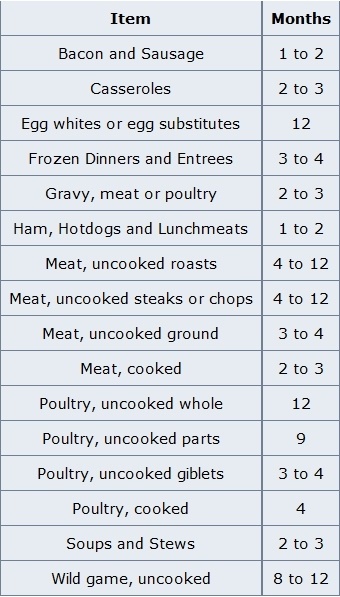
I love this little freezer storage list, since we all mark the date on our freezer items so we know how long they have been in the freezer (ahem!), this is a handy addition to any freezer door. Click on the picture to get a decent size for printing out.

Speaking of food - How to buy eggs.. Do you know the difference in appearance between a AA grade egg and an A grade egg? I didn't. And it's interesting to read about how other countries grade their eggs as well.

And speaking of shopping - Do you know the best time to buy? The Go Frugal blog has a list of 75 products and services and the best time to buy them. It is a handy guide to bookmark as I know I won't need all the information now, but good to refer back to.. like the airline tickets. Keep watch months in advance.

And if you are tired of shopping and it doesn't bring you happiness - Modern Tightwad has a great Rule of Things that I fully agree with.

Finally, if all you want to do is learn I have a few links that have some great links of their own for free online learning:

➤ Lifehacker recently gave info on Foreign Service Institute's free language courses - "you can access audio, texts, and tests in 41 different languages" So don't buy that Rosetta Stone software until after you check this out.
➤ I stumbled on Education Portal when looking for free accounting classes
➤ And The Buck List has 10 free online sites for colleges and courses. I have watched some of the videos from the MIT OpenCourseWare.

         We Guarantee the Lowest Prices!  We Will Beat Any Advertised Price!

These promotions are around so often that we don't always notice them, and how often do we take them up on their promotion? We should, it can help us save cash, gas and time. This is how you become a pricing match maker, by taking them up on their offers to meet or beat an advertised item. It is really a win-win for all parties as they are looking for you to spend money in their store and you want to save money without the hassle of running around and you get exactly what you are looking for.

Price matching is commonly done with larger retail stores and some online stores, it is not too common to price match with a mom and pop store that has more set prices. However the biggest positive in that regard is that you are buying local to help a small business out, but I digress.

It is very rare that you will find stores that will price match with online websites as the websites have a lower overhead and can set a lower price. And this can include their own website - such as Best Buy not matching BestBuy.com online only offers. Though I have seen store/website matching done, sometimes it has involved a store manager to approve it.

 All companies need proof that the competitor is at a lower price than them, and occasionally they will call to verify with the store to make sure it is.

Most stores have other rules on price matching that vary from store to store -
  • Gift Cards or Rebates
  • Time Limits on the Advertised Item
  • In Person Price Matching
  • Competitor's Item being in Stock or not
  • Competitor's Distance from the store
  • Model Type or Number
Most price matching is based on a specific model, but can occasionally vary in size, color, etc. Such as a certain color of luggage or size of curtains. But occasionally you can work with them on price if exact model isn't what they have but you like their item better.

Groceries are the hardest to match because there are such a wide variety, and if you use coupons you are already familiar with the 'rules' to purchasing. It is best to have a copy of the ad with you when you shop for not only proof, but also to get the exact item you are price matching. Occasionally you can take a store coupon in and get that amount off the price - for instance taking a Kroger store coupon to a Safeway and getting 35¢ off even though they don't get money back on the coupon (and they will keep the coupon)

When you are price matching in a store make sure you let the cashier know ahead of time so they can have the item overridden with the lower price. Even better is to make certain the store will price match that specific item. For instance, it is depends on the store if Black Friday ads are price matched simply because they have a small number of them or they know they will sell out without difficulty and there is no need to reduce the price. So call ahead to the store to find out and bring proof.

Price matching is not done on clearance items or returned items. Though if you have bought a product from another store you could try to bring that receipt into the store to show as proof before you return the item to former store.

Some people find price matching a benefit, while others find it too much work. It usually does have exclusions, and you’ll have to jump through some hoops in most cases to get it. Many people find it worth a little effort when they’re trying to save.

Here are a few stores Price Matching FAQs:


Photo courtesy of MNgilen via Flickr CC

Frugal living can get boring to those who are new to it because it doesn't seem like you to get to buy anything you want or simply spend money on a whim anymore. Tightening our belts can be a hard lifestyle change. But when the frugal living boredom sets in it's time to sit down determine a new challenge for yourself to keep going to move forward to the goal you have given yourself.

Challenges are a wonderful part of life, they make us into better people or help us see where we need to do better. Without challenges in life we don't learn and grow. I know I don't like having challenges come up from a blind spot, so why not make my own frugal challenges, on my own terms?

These types of frugal challenges are more of a game in my opinion because they help me build a habit, I can enjoy the sweet taste of victory when it is over or feel the disappointment and resolve to do better next time. Frugal challenges are useful because even if you fail, you have moved down that road of frugality in some form, either by saving money, spending less or wearing down a new path for a habit to form.

It seems that after all that we voluntarily or involuntarily go through we should received some kind of recognition, a challenge coin to show to the world that we have a unique membership. Maybe it could be divided up in to categories. A challenge coin for those who master the art of bartering and deal-making, mastering the fix-it-yourself challenges, a coin to master the art of home-made and so on. No coin is better than another, just simply categories to in the challenge of frugal living.


Some challenges that you could turn into a game (and all games eventually have an ending).
  • Summer or Winter challenge to see how long you can go without using A/C or Heat. This challenges you to find new ways to keep warm or keep yourself cool.
  • The Pantry challenge that uses only the food you have bought for stocking up over the years. No more buying new food, you have to use what you already have in the freezer and on the shelves.
  • A Generic buying challenge that requires you to try the generic version of what you would normally buy in name brand items. Of course if you don't like it, you now know to cross it off your list and then you can use up the "bad" food for a work potluck.
  • The Second-Hand challenge where you only buy items second hand - furniture, clothes, appliances, toys - for a certain period of time, no matter what. Some people I know are masters of this already, but that is why we have so many cool challenge categories!
  • A Home-made challenge of your choosing, whether it be to cook at home when you usually go out to eat quite a bit or to make your own home-made cleaners. If you are not a cooking master like myself, start easy by taking your lunch every single day to work.
  • How about a No Electricity challenge to unplug anything not in use, keep the lights off for as long as possible through the day and use low electricity items to cook.
  • Let's not forget a Drive Less challenge to master the art of one trip errand running, and then challenge yourself not to drive 1-2 days a week and see how much longer you can go before filling up with gas again.
It is these small challenges that can ease you into a frugal living lifestyle or get you back into the game again. And though there are no real frugal challenge coins to be given out, I do hear the jingle of coins in pockets, purses and piggy-banks that are testament to others that we have a wonderful membership of people in this club!

I was sent this via email, you may have seen but I thought it was cute and instead of forwarding it to everyone ... I'll just post it here and YOU can forward it to everyone!

By the way, anyone see a flaw in this reasoning? It seems to good to be true.

It's a slow day in a little Lancashire town. The sun is beating down, and the streets are deserted.
Times are tough, everybody is in debt, and everybody lives on credit.

On this particular day a rich tourist from down south is driving through town. He stops at the motel and lays a £100 in cash on the desk saying he wants to inspect the rooms upstairs in order to pick one to spend the night.

As soon as the man walks upstairs, the owner grabs the bill and runs next door to pay his debt to the butcher.

The butcher takes the £100 and runs down the street to repay his debt to the sheep farmer.
The sheep farmer takes the £100 and heads off to pay his bill at the supplier of feed and fuel.
The guy at the Farmer's Co-op takes the £100 and runs to pay his debt to the local prostitute, who has also been facing hard times and has had to offer her "services" on credit.
The hooker rushes to the hotel and pays off her room bill with the hotel owner.
The hotel proprietor then places the £100 back on the counter so the rich traveler will not suspect anything.

At that moment the traveler comes down the stairs, picks up the £100, states that the rooms are not satisfactory, pockets the money, and leaves town.

No one produced anything.. No one earned anything.
However, the whole town is now out of debt and now looks to the future with a lot more optimism.


photo courtesy flickr cc via Horia Varlan